
Rendering
Covering Harrogate, Leeds, York, Bradford and across North & West Yorkshire
22 years’ experience
Long enough to have seen most versions of a job before.
Public liability insured
Backed by a written guarantee on every job — ask when you quote.
Free, no-obligation quotes
We look at the job and give you a price. Nothing to pay if you don’t go ahead.
Why it matters
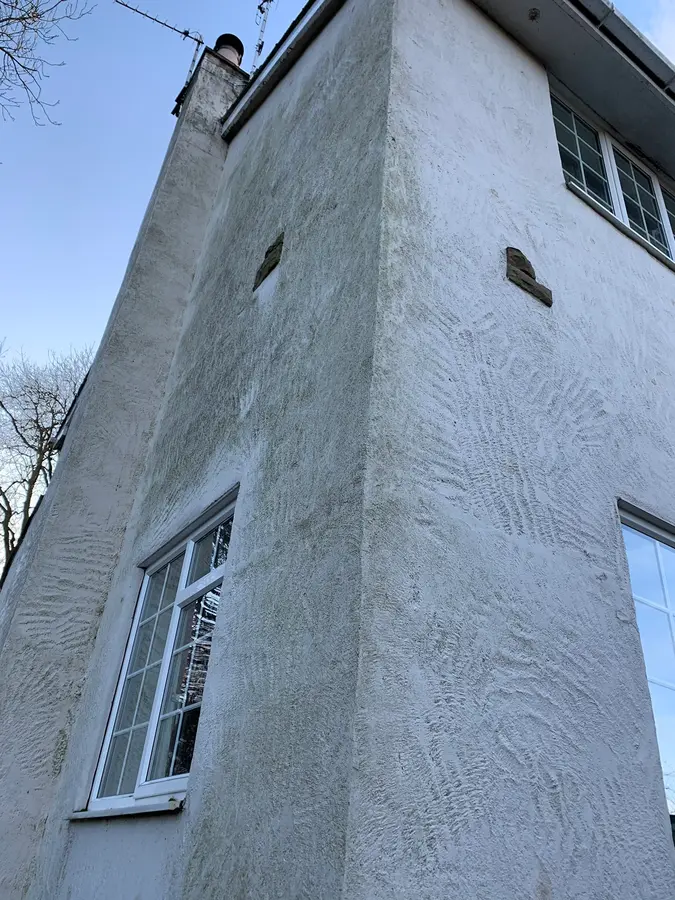
Render is the wall’s raincoat. While it is sound it keeps water out of the masonry; once it has cracked or blown it holds water against the wall instead, and the damp inside usually arrives before anyone notices the crack outside.
What the job involves
- Find out why it failed before quoting to replace it — a blown section above a leaking gutter will blow again.
- Tap the elevation off to find the hollow areas, which are almost always larger than the visible damage.
- Cut back to sound material, and deal with whatever caused it.
- Rebuild in coats, with beads and mesh where the substrate changes or the elevation is prone to cracking.
- Finish in a through-coloured silicone or a painted system, depending on the wall and the exposure.
What it costs
£45–£85 per m² for a full elevation; patch repairs from around £300 is the typical UK range for this work — scaffold is usually additional. That is a guide to the market, not a quote: yours is free, fixed before we start, and based on your actual property.
What moves the price:
- elevation area, height and how much scaffold it needs — on a full elevation the scaffold is a real share of the price
- patch repair against a whole elevation, and whether a patch will ever match
- the substrate: stone, brick, blockwork and existing pebbledash all behave differently
- the finish — through-coloured silicone costs more than sand and cement and painting, and does not need repainting
- what caused the failure, and what it takes to stop it happening again
When to do it
Spring to autumn. Render cannot go on in frost and does not want to be rained on before it has set, so late spring and early autumn are the reliable windows. Winter work is possible under sheeting but it is slower and it costs more.
Different roofs and walls need different handling
Millstone grit. Millstone grit walls are solid rather than cavity, which changes everything about how the wall handles moisture — a render that cannot breathe traps it in the stone. On solid stone the finish has to be vapour-permeable, and lime has a genuine claim over cement here.
Magnesian limestone. Magnesian limestone is soft and takes a permeable finish far better than a hard cement one, which will crack off it and take the face of the stone with it.
Brick. Brick is the most straightforward substrate to render onto, though solid brick walls want a breathable finish for the same reason stone does.
How much does rendering a house cost? goes into the numbers and the reasoning in more detail.
Where we do it
We work out of Harrogate across North and West Yorkshire. Every town below has its own page for this service:
Related work
exterior painting, pressure washing and damp proofing are the jobs most often booked alongside this one.
Questions
Frequently asked questions
Can you render over pebbledash?
Often yes, if the pebbledash is sound and well bonded — it is tapped off first to find the hollow areas, and those are cut out. If a large share of it is loose, taking it all off is cheaper than rendering over it twice. Rendering over failing pebbledash guarantees the new work fails with it.
How much does rendering a house cost in the UK?
Broadly £45 to £85 per square metre for a full elevation, with scaffold usually on top. Patch repairs start around £300. The spread is mostly the finish and the access: a through-coloured silicone on a scaffolded three-storey and a sand-and-cement patch on a bungalow are barely the same job.
Does rendering a house cause damp?
The wrong render can. A hard, non-breathable cement render on a solid stone or brick wall traps moisture that used to evaporate out, and it shows up as damp inside. On a solid wall the finish needs to be vapour-permeable. Render itself is not the problem — render that cannot breathe on a wall that needs to is.
How long does render last?
Twenty to thirty years for a sound sand-and-cement system, and longer for modern silicone finishes, which also keep their colour instead of needing repainting every five years. What actually shortens it is nearly always water getting in from somewhere else — a failed gutter, a bad flashing, a missing bead.
Why is my render cracking?
Usually movement, water, or a substrate change with nothing to bridge it. Fine hairline crazing is often cosmetic. Cracks that run in a line, that step, or that sound hollow when tapped are structural or bond failures and want looking at, because they are letting water into the wall behind.
For exterior work across Harrogate and Yorkshire, please call 07788 585240