
Soft washing vs pressure washing
A straight answer, with typical UK prices — and when not to bother
22 years’ experience
Long enough to have seen most versions of a job before.
Public liability insured
Backed by a written guarantee on every job — ask when you quote.
Free, no-obligation quotes
We look at the job and give you a price. Nothing to pay if you don’t go ahead.
Which surface takes which
| Surface | Method | Why |
|---|---|---|
| Roof — any covering | Soft wash | Pressure drives water under the laps and cracks tile |
| Render | Soft wash | Render is a coating; pressure removes it |
| Painted masonry | Soft wash | Strips the paint film |
| Soft limestone, sandstone | Soft wash | Scours permanently and will not blend back |
| Millstone grit, hard stone | Either, carefully | Takes pressure; the mortar joints do not |
| Brick | Moderate pressure | The pointing sets the limit, not the brick |
| Block paving | Pressure | Fast and safe — but the sand comes out and must go back |
| Concrete flags, paths | Pressure | Hard-wearing, nothing to lose |
| Tarmac | Low pressure only | Bitumen-bound; a hard jet strips the surface |
What soft washing actually is
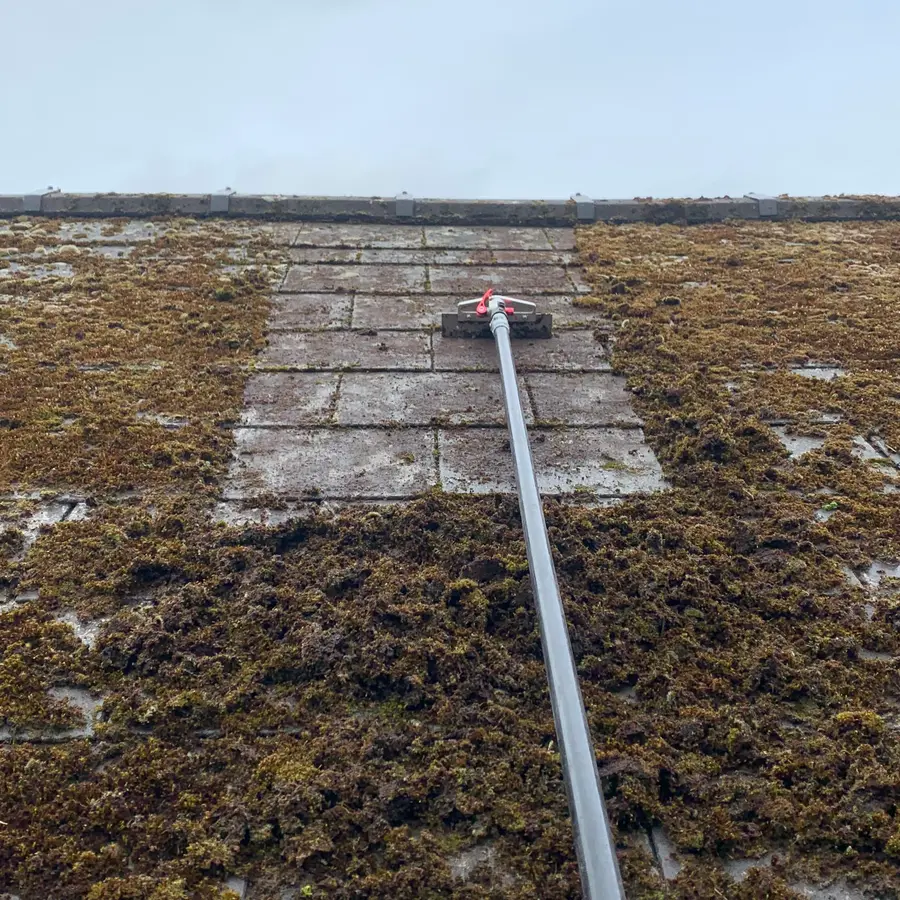
Low pressure — closer to a garden hose than a jet — with a biocide applied and left to work. It kills the algae, lichen and moss at the root. The growth then dies off and weathers away over the following weeks rather than being blasted off on the day.
That is the trade-off worth knowing about: a soft-washed roof does not look finished the moment the van leaves. It keeps improving for a month or two. A pressure-washed roof looks dramatic immediately and is green again in two seasons, because the spores were never killed.
What pressure washing is for
Hard, non-porous, ground-level surfaces where the dirt is on top and the surface underneath can take it. Block paving, concrete, flags, hard stone. Here pressure is the right answer — it is faster, it needs no chemistry, and there is nothing to damage.
The one thing to plan for is the jointing. Almost any pressure washes sand joints out of block paving, so re-sanding with kiln-dried sand is part of the job, not an extra.
The damage the wrong choice does
It is nearly always permanent, and it is nearly always more expensive than the clean was.
- Concrete tile has a surface coating that resists moss. Pressure removes it, and the roof greens faster afterwards than it did before.
- Clay pantile cracks. Individually bedded, brittle, and expensive to match.
- Render comes off in sheets, or the colour goes and the patch is permanent.
- Soft stone scars — a lighter, rougher patch that no later work blends in.
- Loose pointing empties out, and then the wall is taking water.
How to tell what you are being sold
Ask what pressure they will use on the roof. Anyone who answers with a number in bar or PSI for a roof is planning to pressure wash it. The right answer is that the roof gets scraped and treated, not blasted.
Getting a price on your own house
An average is not a quote. We look at the actual property, price the actual job, and fix it before anything starts — free, with no call-out fee and nothing to pay if you decide against it.
See pressure washing, or the towns we cover it in: Leeds, York, Harrogate and Bradford.
Questions
Frequently asked questions
Is softwashing better than pressure washing?
Neither is better — they are different tools. Soft washing is right for roofs, render, painted walls and soft stone, where pressure removes the material along with the dirt. Pressure washing is right for block paving, flags and concrete, where it is faster and does no harm.
Is it wise to pressure wash a roof?
No, on most UK roof coverings. High pressure drives water under the laps, strips the protective coating off concrete tile and cracks clay pantile. Roofs are a soft wash surface — take the bulk off dry, treat with a biocide, and let it weather clean.
When should you not power wash your house?
On render, painted masonry, soft limestone, roofs, and anywhere the pointing is already loose. All of those are coatings or soft materials where pressure removes the surface rather than the dirt on it.
Can I use my pressure washer as a soft wash system?
Not properly. Soft washing is low pressure plus the right chemistry, and a domestic pressure washer has no way to apply and dwell a biocide safely. Turning the pressure down gets you a weak rinse, not a soft wash.
For exterior work across Harrogate and Yorkshire, please call 07788 585240