
Does roof moss damage tiles?
A straight answer, with typical UK prices — and when not to bother
22 years’ experience
Long enough to have seen most versions of a job before.
Public liability insured
Backed by a written guarantee on every job — ask when you quote.
Free, no-obligation quotes
We look at the job and give you a price. Nothing to pay if you don’t go ahead.
What the moss actually does
It holds water against the covering. A roof works by shedding water fast. A layer of moss is a sponge sitting on it, keeping the tile or slate wet for days after rain instead of hours. On a clay or concrete tile that matters most in winter: trapped water freezes, expands, and spalls the surface off the tile.
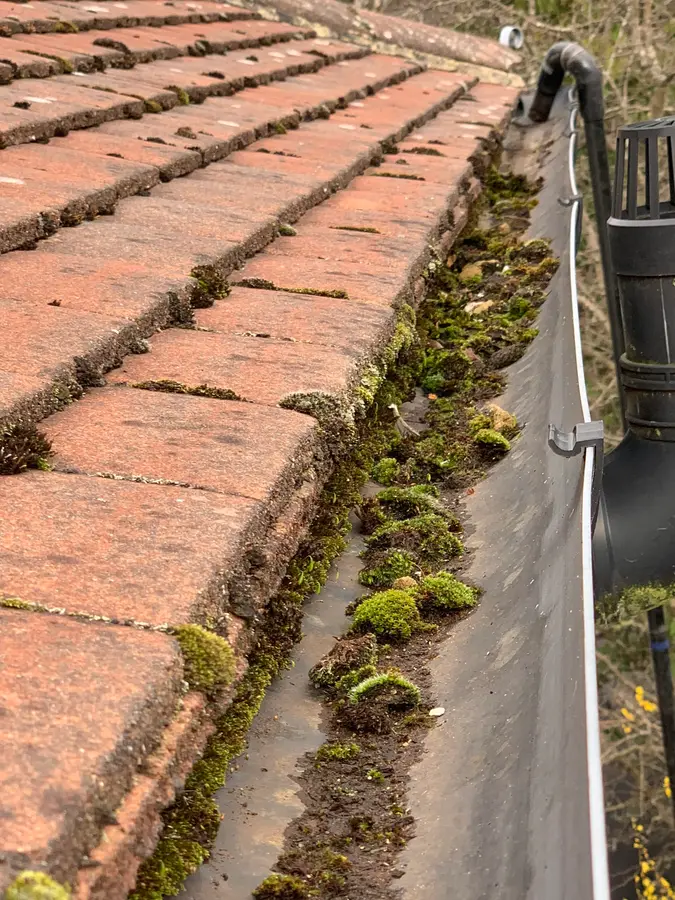
It lifts the laps. Moss grows into the overlap between tiles and, as it thickens, physically separates them. That is a direct route for wind-driven rain to get past the covering — and it is why moss damage often shows up first as a damp patch in a loft rather than as a broken tile.
It blocks the gutters. Moss constantly sheds. It ends up in the run, in the hoppers and in the outlets, and the gutter overflows behind the fascia.
It adds weight. Wet moss is heavy. A fully covered roof can carry a meaningful additional load — rarely a structural problem on its own, but it does nothing good.
When it is doing real harm — and when it is not
| What you see | What it means |
|---|---|
| Green tinge, flat against the tile | Algae. Cosmetic. Leave it. |
| Patchy moss in the laps, a few mm | Early. Worth treating, not urgent. |
| Continuous moss, 10mm+, cushiony | Holding water. Deal with it. |
| Moss in the gutters, plants growing | Already causing damage. |
| Clumps falling into the garden | The laps are lifted. Act now. |
Which roofs suffer most
North-facing pitches, shaded roofs, and anything near trees. On this patch the moor-edge towns — Ilkley, Menston, the higher parts of Otley — grow noticeably more moss than the low-lying Vale of York towns, because they get more rain and more shade.
Porous coverings hold it worst. Yorkshire stone slate and old clay tile take moss deep into the grain; smooth concrete tile and Welsh slate shed it more readily, at least until their surface has weathered.
Why cleaning alone does not work
Physical removal takes off what you can see. It does not touch the spores in the surface of the covering, and those regrow — usually visibly within two seasons.
This is why the biocide treatment at the end is not an upsell. It is the part that decides whether you are doing this again in two years or in eight.
The thing not to do
Do not pressure wash it. On clay pantile it cracks tiles; on concrete tile it strips the surface coating that was resisting the moss in the first place, so the roof greens up faster afterwards than it did before; on any covering it drives water under the laps.
The moss is a problem. A pressure washer is a worse one.
Getting a price on your own house
An average is not a quote. We look at the actual property, price the actual job, and fix it before anything starts — free, with no call-out fee and nothing to pay if you decide against it.
See roof cleaning, or the towns we cover it in: Leeds, York, Harrogate and Bradford.
Questions
Frequently asked questions
Is it bad to leave moss on your roof?
It is bad once the moss is thick enough to hold water in the laps or heavy enough to be filling the gutters. Below that it is cosmetic. The problem is that it does not stay below that — moss spreads and thickens season on season, and the cost of dealing with it rises with it.
Does roof moss damage tiles?
It does. Moss holds moisture against the tile, which accelerates frost damage in winter as trapped water freezes and expands. It also works between the laps and lifts them, letting wind-driven rain past the covering.
What kills moss on a roof best?
A biocide treatment, applied after the bulk of the growth is removed. It kills the spores left behind, which is what stops the regrowth — physical removal alone leaves the roof looking clean and re-greening within two seasons.
What is the white powder people put on their roofs?
Usually a zinc or copper sulphate powder, sold as a moss inhibitor. It works slowly and only where rain washes it down the roof, so coverage is patchy and it does nothing about growth already established. A proper biocide treatment is more reliable.
For exterior work across Harrogate and Yorkshire, please call 07788 585240