
Roof cleaning
Covering Harrogate, Leeds, York, Bradford and across North & West Yorkshire
22 years’ experience
Long enough to have seen most versions of a job before.
Public liability insured
Backed by a written guarantee on every job — ask when you quote.
Free, no-obligation quotes
We look at the job and give you a price. Nothing to pay if you don’t go ahead.
Why it matters
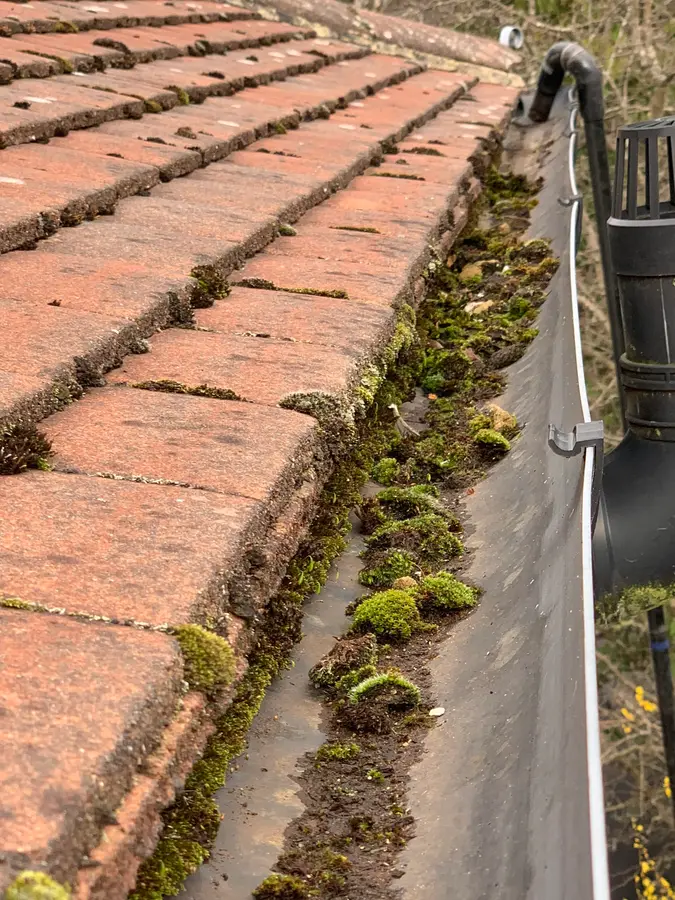
Moss holds water against the covering, lifts the laps and finds its way under the tiles. Left long enough it stops being a cosmetic problem and starts being a roof problem.
What the job involves
- Look at the roof first, from the ground and from a ladder, and say what it needs before anything is quoted.
- Scrape and brush the bulk of the moss off dry, working down the pitch so nothing is driven under the laps.
- Clear the gutters, hoppers and outlets of everything the roof has just shed — a roof clean that leaves the moss in the gutter has moved the problem, not solved it.
- Treat the covering with a biocide so the regrowth is slowed rather than starting again from the spores left behind.
- Run water through the system at the end to prove it drains.
What it costs
£350–£900 for a standard three-bedroom semi is the typical UK range for this work — steeper, larger or scaffold-access roofs sit above this. That is a guide to the market, not a quote: yours is free, fixed before we start, and based on your actual property.
What moves the price:
- roof area and pitch — a steep roof is slower and needs more securing
- how deep the growth is, and whether it has got under the laps
- access: a clear run at the eaves against a conservatory, extension or tight alley
- whether the gutters are being cleared at the same time, which they normally should be
- the covering itself — a brittle pantile is slower than a concrete tile
When to do it
Spring and early autumn are the useful windows. Moss is softest and lifts most cleanly after wet weather, and treating in autumn gets ahead of the winter growth. Deep frost and high wind stop the job for safety rather than for quality.
Different roofs and walls need different handling
Clay pantile. Clay pantiles are individually bedded, deeply curved and genuinely brittle — they crack under a knee as readily as under a lance. On pantile the work is soft washing and hand-clearing rather than pressure, and the roof is worked from ladders and boards rather than walked.
Yorkshire stone slate. Yorkshire stone slate is porous, heavy and laid in diminishing courses, so it holds moss deep in the grain and a single replacement unit is expensive and hard to match. It takes a patient dry strip and a biocide rather than anything forceful.
Welsh slate. Welsh slate is dense and sheds water well once it is clear, but the nibs and pegs holding it are the weak point and a hard jet finds them. Moss tends to sit in the laps rather than in the material.
Concrete tile. Concrete tile is the most forgiving covering on this patch and tolerates a firmer approach, though its surface coating is what stops it greening again and that coating is exactly what over-pressuring removes.
How much does roof cleaning cost in the UK? goes into the numbers and the reasoning in more detail.
Where we do it
We work out of Harrogate across North and West Yorkshire. Every town below has its own page for this service:
Related work
gutter cleaning, pressure washing and fascia and soffit cleaning are the jobs most often booked alongside this one.
Questions
Frequently asked questions
What time of year is best for roof cleaning?
Spring and early autumn. Moss lifts most cleanly when it is damp rather than baked on, and an autumn treatment gets ahead of the winter growth so the roof goes into the wet months clear. Work stops for hard frost and high wind, which is a safety limit rather than a quality one.
How often should a house roof be cleaned?
Every three to five years for most houses. On a shaded, north-facing or moor-edge roof it is closer to three; on an open, sunny roof out in the Vale it can be longer. A biocide treatment at the end of the clean is what stretches the interval, because it kills the spores left behind rather than just the growth you can see.
Is it wise to pressure wash a roof?
Not on most of the coverings around here. High pressure drives water under the laps, strips the surface coating off concrete tile and cracks clay pantile. The safer method is to take the bulk off dry, then treat the covering with a biocide and let it weather clean. Pressure has its place on hard surfaces at ground level, not on a roof.
What are the downsides of roof cleaning?
Done badly, it costs you a roof. Aggressive pressure breaks tiles, forces water into the loft and removes the very surface that was resisting the moss — and cleaning without treating means the growth is back within a couple of seasons. Done properly it is low-risk, and it buys back the roof's ability to shed water.
Is it worth having your roof cleaned?
It is worth it when the moss is deep enough to hold water in the laps or heavy enough to be filling the gutters, because at that point it is shortening the life of the covering and backing water up at the eaves. If the roof is only lightly discoloured, it is a cosmetic job and can wait.
For exterior work across Harrogate and Yorkshire, please call 07788 585240